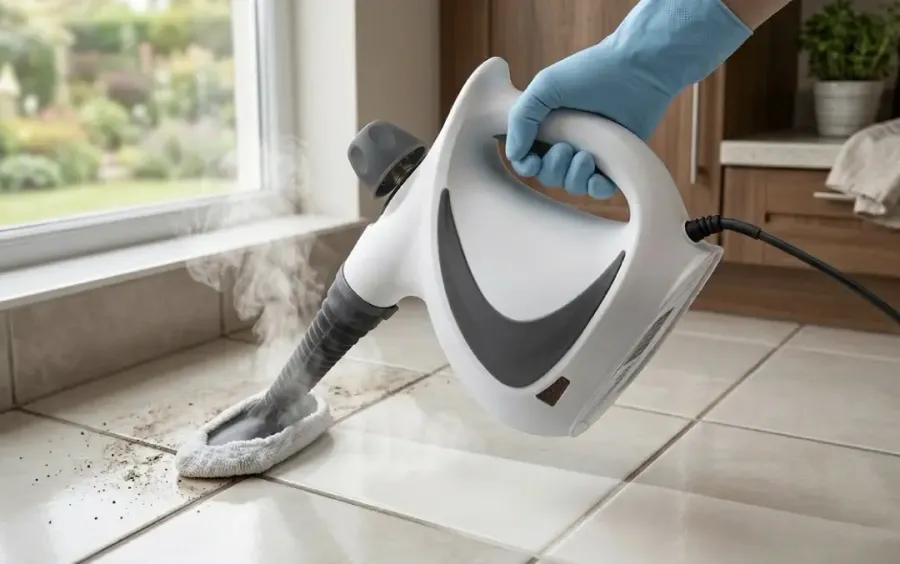
Walk down the cleaning aisle and you will find three very different answers to the same problem: a steam mop, a handheld steam cleaner and a wall of sprays. They overlap less than you would think. Here is what each one is really good at, so you buy the right tool once.
The quick answer
In one paragraph
Choose a steam mop if your main job is mopping large areas of sealed tile or vinyl floor. Choose a handheld steam cleaner if your pain points are grout, kitchen grease, bathrooms, glass, upholstery and car interiors — the detailed jobs that take the most time. Sprays are fine for a quick wipe, but they leave residue, need constant rebuying and still require scrubbing.
Steam mops: great floors, and that’s about it
A steam mop is an upright stick with a water tank and a flat pad at the bottom. It is excellent at what it was designed for: sanitizing and refreshing large areas of sealed hard floor without a bucket. But the flat pad can’t reach into grout lines, can’t climb a backsplash, can’t clean a window and can’t touch a couch. Once the floor is done, it goes back in the closet.
Handheld steam cleaners: the detail specialists
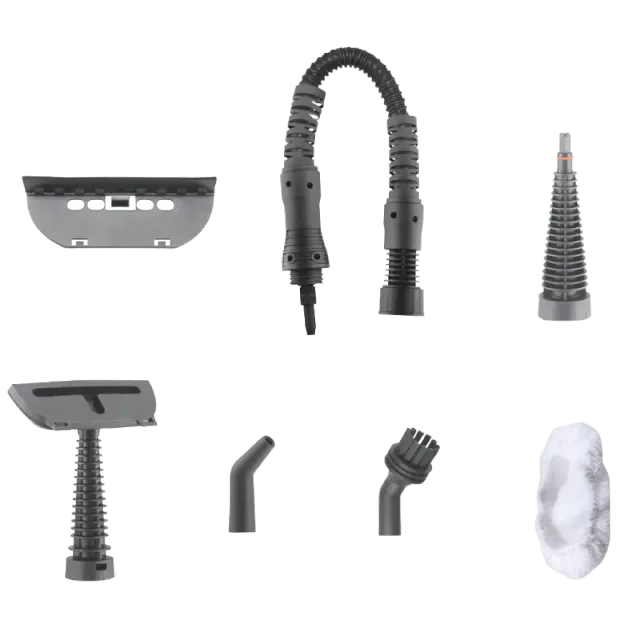
A handheld steam cleaner is a compact unit you hold in one hand, with a trigger and a set of attachments: jet nozzles for grout and corners, brushes for stovetops, a squeegee for glass, a fabric cover for upholstery and often an extension hose. Instead of covering a large flat area, it concentrates steam exactly where dirt hides. That makes it the tool for:
- Grout lines and tile corners — the narrow jet goes where a mop pad never can.
- Kitchens — range hoods, stovetops, oven doors, sinks, faucets, backsplashes.
- Bathrooms — shower tiles, glass doors, toilet bases, mildew in corners.
- Glass and window tracks — streak-free with a squeegee head.
- Upholstery and cars — couches, mattresses, car seats and mats.
Sprays and scrubbing: the expensive habit
Sprays rely on chemistry instead of heat. They work, slowly: spray, wait, scrub, rinse, repeat. Each surface tends to want its own product, the bottles run out, and the residue they leave behind is exactly what you don’t want on a kitchen counter or a floor where a toddler or a dog spends the day. Over a year, the refills alone often cost more than a steam cleaner.
Side-by-side comparison
| Job | Handheld steamer | Steam mop | Sprays |
|---|---|---|---|
| Grout & corners | Excellent | Weak | Hard scrubbing |
| Kitchen grease | Excellent | No | Slow |
| Glass & mirrors | Yes | No | Yes |
| Upholstery & car | Yes | No | Varies |
| Large floors | Spots & edges | Best | Slow |
| Residue | None | None | Yes |
| Running cost | Water | Water + pads | Ongoing refills |
Our pick for most homes
If you already own a regular mop or vacuum for floors, the tool that will save you the most time is a handheld steam cleaner, because it takes over the slow, detailed jobs. The one we recommend is the Qinux Vapoxis: it heats up in minutes, uses only water, ships with the full set of attachments (jet and angled nozzles, round brush, window squeegee, microfiber cover and extension hose) and is rated 4.8/5 by owners on the official site.
Frequently asked questions
Is a handheld steam cleaner better than a steam mop?
They do different jobs. A steam mop is built for large stretches of sealed hard floor. A handheld steam cleaner handles everything above the floor — grout, stovetops, backsplashes, glass, faucets, upholstery and car interiors — plus floor spots and corners. For most homes, the handheld covers more of the time-consuming jobs.
Do steam cleaners really clean without chemicals?
Yes. Hot, pressurized steam softens grease and soap scum and lifts dirt so it can be wiped away. Steam is also widely used to sanitize surfaces. That is why steam cleaners only need tap water.
Are steam cleaners expensive to run?
No. After the purchase, the only running cost is water and a little electricity. Compare that with sprays and refills that need replacing every few weeks.