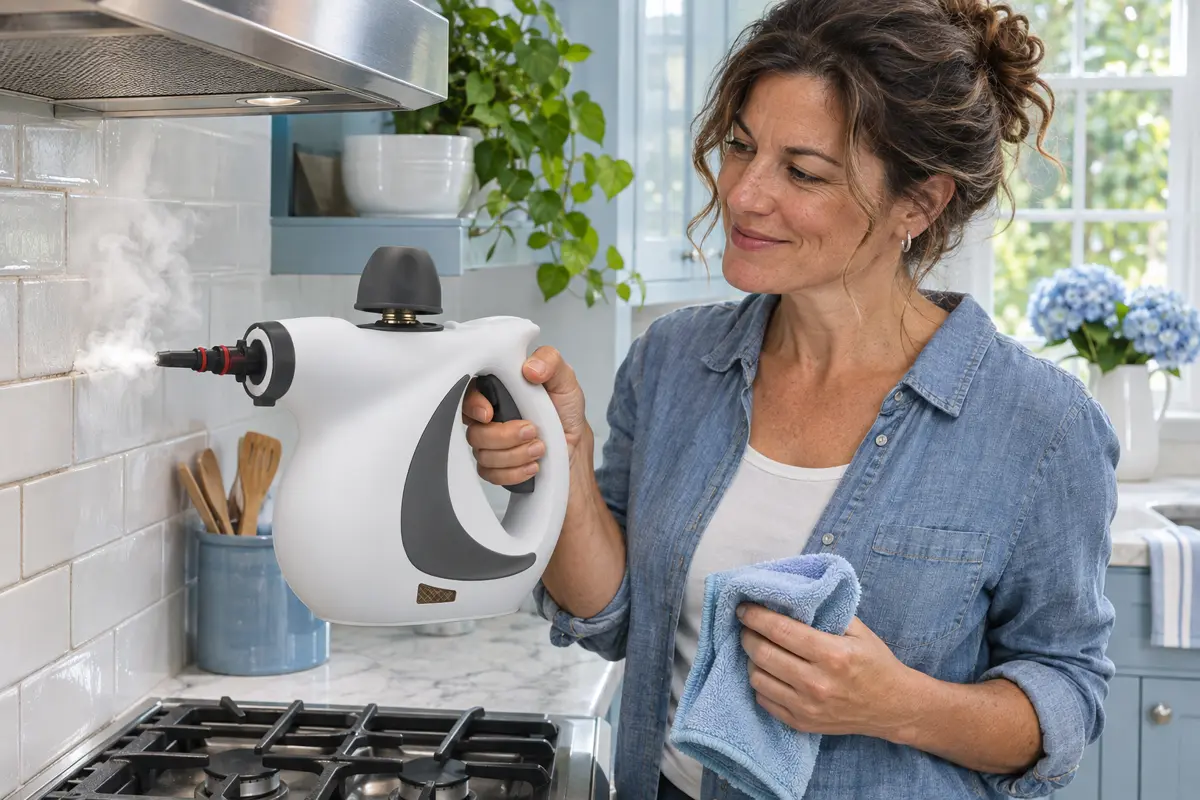
The quick answer
A steam cleaner heats water to boiling and pushes it out as steam at around 212°F (100°C), sometimes a little more under pressure. But steam cools fast in the air, so the heat that reaches your tile or sofa depends on how close and how slowly you work. Makers, independent testers and the EPA all agree on that, and on one more thing: germ-kill percentages are results measured under specific test conditions, not a promise for every quick pass.
“How hot does a steam cleaner get?” is a question people ask for two reasons: to know whether it is safe for a surface, and to know whether it is hot enough to sanitize. The numbers online range from “boiling” to boiler temperatures in the hundreds of degrees, which is confusing. So instead of adding another number, we put three kinds of sources side by side: a major steam cleaner maker that publishes its test conditions, an independent consumer tester, and the U.S. Environmental Protection Agency. Below is what each says, where they line up and where they split.
Three sources, side by side
| Source | What it says | Type / link |
|---|---|---|
| Kärcher (steam cleaner maker), thermal disinfection page | Steam escapes the nozzle at 100°C and higher under high pressure. An independent lab measured a 99.999% reduction of a test bacterium on PVC, at a slow traverse of 30 cm per second, on specific models; coarse dirt has to be removed first. | Manufacturer, kaercher.com |
| Which? (consumer testing organization), April 2020 | Steam cools quickly in the air, so hold the nozzle close. There is no simple rule for how long to apply it; spend a little longer than usual, within the manual’s limits. Makers’ 99.9% claims are not checked in Which?’s own lab. Mop pads absorb some of the heat. | Independent tester, which.co.uk |
| U.S. EPA, Pesticide Devices: A Guide for Consumers | Products that work by physical means (rather than a chemical) are devices that do not need EPA registration. An EPA establishment number is not an approval, and makers may not make false or misleading claims; they must keep data to support them. | Government agency, epa.gov |
We list only what each source states on the pages linked above, checked in November 2026.
Where all three agree
- Steam leaves the nozzle at about boiling point.Around 212°F (100°C), a little higher under pressure. That is hot enough to soften grease and loosen grime fast, which is the main job of a household steam cleaner.
- Distance changes everything.Steam cools as soon as it mixes with room air. Which? says to keep the nozzle close; Kärcher’s results were measured with the tool on the surface, not sprayed from a distance.
- Speed and contact time matter.Kärcher’s lab figures use a slow 30 cm (about 1 foot) per second pass; Which? advises spending a bit longer than usual. A quick wave across a counter delivers far less heat.
- Dirt first, then the hygiene step.Kärcher notes that coarse dirt must be removed first because germs can hide underneath. In practice, steam and wipe, then give high-touch spots a second, slower pass.
- Percentages come with conditions.A germ-kill figure is a lab result for a specific organism, surface and technique. The EPA adds that steam devices are not reviewed for efficacy by the agency, which is why reading the conditions matters.
Where they differ, and why
1. “How hot” depends on where you measure
Marketing often quotes the boiler or heating-element temperature, which can be well above boiling. Kärcher quotes the steam at the nozzle (100°C and higher). Which? points out the temperature drops quickly once steam leaves the tool, and that a mop pad absorbs part of it. All three can be true at once: hottest inside, around boiling at the tip, lower on the surface.
2. How long is long enough
Kärcher’s page says extremely short contact times are sufficient under its test conditions; Which? says there is no simple rule and recommends a little extra time. The difference comes from method: a lab measures one organism on a smooth test surface at a fixed speed, while a home has grout lines, fabric and grease that slow heat down.
3. What counts as “disinfecting”
The EPA reserves registered disinfectant claims for chemical products tested under its rules, while steam is a physical method that the agency does not register. That is why responsible makers phrase claims as lab results (“eliminates up to 99.9% of bacteria”) rather than as registered disinfection, and why public-health guidance still points to registered disinfectants for specific illness situations.
What the consensus means in your kitchen and bathroom
| Technique | How to do it | Why |
|---|---|---|
| Nozzle distance | Close to the surface, about the width of a finger or two | Steam is hottest right at the tip |
| Speed | Slow, about a foot per second, on high-touch spots | Matches the pace used in published lab tests |
| Order | Steam, wipe the loosened dirt, then a slower second pass | Germs hide under grime |
| Attachments | Jet nozzle for grout and seams; brush for textured tile; cloth covers last | Pads and cloths absorb heat |
| Surface check | Test a hidden spot on wood, laminate, paint or fabric | Heat and moisture can mark sensitive finishes |
Not sure where steam belongs at all? Our list of what you can and cannot steam clean covers each surface, and how a steam cleaner works explains the heat, pressure and water behind it. For the mold question specifically, see does steam kill mold.
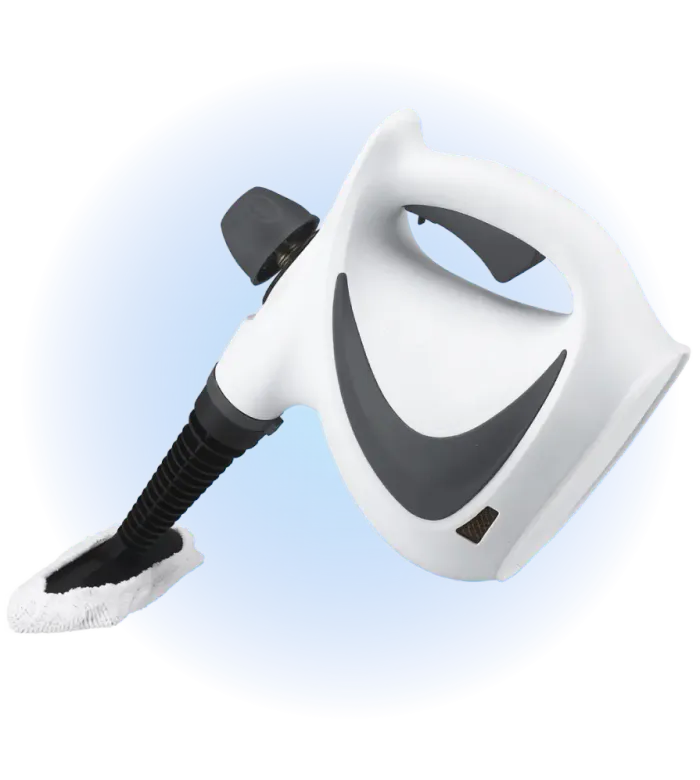
Our recommendation: Qinux Vapoxis
If every source agrees that the heat is at the nozzle and the technique decides the result, the best tool is one that puts that nozzle exactly where you need it. That is why we recommend the Qinux Vapoxis. It is a compact handheld steam cleaner that runs on plain tap water, so you can bring hot steam within a finger’s width of grout lines, faucet bases, stovetop edges and window tracks, move slowly where it matters and wipe the loosened grime straight away. The maker states its steam eliminates up to 99.9% of bacteria on treated surfaces; used with the close, slow technique above, it is the most practical way we know to get both a clean and a hygienic finish without chemicals.
- Handheld and precise — the jet nozzle reaches seams, corners and grout where heat matters most.
- Water only — no fumes or residue in small kitchens and bathrooms.
- Full attachment kit — jet and angled nozzles, round brush, window squeegee, flat tool with microfiber cover and extension hose.
- Multi-surface — tile, grout, counters, stovetops, sinks, shower glass, windows, upholstery and car seats.
Owners rate it 4.8/5 from 1,416 reviews on the official site, and 94% would recommend it. One unit is $109, two are $198 ($99 each, the most popular choice) and three $267, with free shipping and a 14-day money-back guarantee from the day of delivery. It is sold only through the official website. Read our full Vapoxis review or compare the packages on the home page.
Always follow the manual and test a hidden spot on sensitive surfaces. For illness-related disinfection, follow public-health guidance and the label of a registered disinfectant.
Frequently asked questions
How hot does a steam cleaner get?
Inside the boiler, water is heated to boiling or above, and steam typically leaves the nozzle at around 212°F (100°C); Kärcher describes steam escaping its nozzles at 100°C and higher under pressure. The temperature that actually reaches a surface is lower and depends on distance, speed and attachments.
How hot does steam need to be to kill germs?
There is no single household number. Heat kills microbes as a combination of temperature and time, which is why testing labs measure germ reduction at a specific temperature, speed and surface. Which? notes there is no simple rule for how long to apply steam, so hold the nozzle close and move slowly.
Does a steam cleaner kill 99.9% of germs?
Many makers claim 99.9% or more, and some, like Kärcher, publish the lab conditions behind it (a specific test organism, surface and a slow 30 cm per second pass). Which? says it does not check these claims in its own lab. Treat the percentage as a result under test conditions, achieved with the right technique.
Is a steam cleaner an EPA-registered disinfectant?
Generally no. The EPA treats products that work by physical means, such as heat, as pesticide devices that do not need EPA registration; an EPA establishment number on the box is not an approval. Makers must still be able to support their claims.
Why does steam feel only warm a few inches from the nozzle?
Steam loses heat very quickly once it mixes with room air, and the tiny droplets cool as they spread out. That is why every source recommends holding the nozzle close to the surface rather than spraying from a distance.
Can steam be too hot for some surfaces?
Yes. Unsealed wood, some laminates, delicate plastics, painted finishes and certain fabrics can be damaged by heat and moisture. Test a hidden spot first and follow the surface maker’s guidance and the steam cleaner manual.