The quick answer
2026 is the year PFAS started leaving store shelves in the cleaning aisle: Colorado and Maine banned the sale of cleaning products with intentionally added PFAS on January 1, Connecticut followed on July 1, Minnesota added a statewide reporting deadline, and Washington’s ban arrives January 1, 2027. For you, it means fewer guesses in those states and a good reason to rethink the spray bottles everywhere else. The simplest way to skip the ingredient question entirely is cleaning with plain water and steam.
PFAS (per- and polyfluoroalkyl substances) are the “forever chemicals” you have probably heard about in water, nonstick pans and stain-resistant fabrics. They are prized because they repel water, oil and grime, and they persist because they break down extremely slowly. Cleaning products are one of the everyday categories where states have moved fastest. Below are the changes that took effect or were scheduled in 2026, each with its date, its source and what it changes for you in practice, followed by what still holds no matter where you live.
What changed in 2026: the timeline
| Date | What changed | Where | What it means for you |
|---|---|---|---|
| Jan 1, 2026 | Sale of cleaning products with intentionally added PFAS prohibited | Colorado | Cleaners sold in the state should be free of intentionally added PFAS |
| Jan 1, 2026 | Same type of prohibition for cleaning products | Maine | Same protection on store shelves in Maine |
| Jul 1, 2026 | Cleaning products with intentionally added PFAS prohibited, unless the seller notified the state in writing beforehand | Connecticut | Most cleaners on shelves move toward PFAS-free formulas |
| Jul 1, 2026 | Reporting deadline for manufacturers of products with intentionally added PFAS (cleaning products already banned since Jan 1, 2025) | Minnesota | More public information on where PFAS remain in products |
| Jan 1, 2027 (scheduled) | Ban on intentionally added PFAS in cleaning products under amended rules | Washington | The next state shelf to change |
Source for the dates above: the law firm Morgan Lewis’s January 2026 summary of state PFAS-in-products laws (“State Regulation of PFAS in Consumer Products Continues to Gain Momentum in 2026”). Laws can be amended, so check your state environmental agency for the current text.
1. Colorado and Maine: the January 1 bans
What happened: on January 1, 2026, Colorado and Maine both began prohibiting the sale or distribution of cleaning products that contain intentionally added PFAS.
What it changes for you: if you shop in these states, the bottles on the shelf should no longer include PFAS added on purpose. “Intentionally added” is the key phrase: the laws target PFAS that manufacturers put in for a function, such as helping a spray spread or leaving a stain-repellent film.
2. Connecticut: July 1 and the notification route
What happened: Connecticut’s prohibition on cleaning products with intentionally added PFAS began on July 1, 2026, with a route for products whose sellers gave the state’s Department of Energy and Environmental Protection prior written notification.
What it changes for you: it is one more large market pushing manufacturers toward PFAS-free formulas, which tends to change products nationwide, not just in one state.
3. Minnesota: from ban to transparency
What happened: Minnesota was first, banning intentionally added PFAS in cleaning products and several other categories from January 1, 2025, under what is often called Amara’s Law. In 2026 the focus shifted to reporting, with manufacturers of products containing intentionally added PFAS required to report by July 1, 2026.
What it changes for you: reporting creates public data on which product types still contain PFAS, which helps shoppers in every state.
4. Washington: next in line for 2027
What happened: Washington amended its rules to ban intentionally added PFAS in cleaning products starting January 1, 2027.
What it changes for you: the trend is clear and still growing; more states are likely to follow.
What still holds, wherever you live
Most US states have no PFAS rule for cleaning products yet, so a few long-standing habits still matter:
- Read the ingredient list. Names with “fluoro” or “PTFE” are a clue; “stain-repellent” or “protective coating” claims deserve a second look.
- Look for certifications. The EPA’s Safer Choice label means each ingredient was reviewed against the program’s safety criteria.
- Never mix products. Bleach with ammonia or acids releases toxic gases; this rule never changes.
- Use less, not more. Many jobs need far less product than people use, as we explain in our guide to alternatives to harsh chemical cleaners.
- Dispose of old products properly. The new laws limit sales; they do not require you to throw away what you own. If you retire a product, use your local household hazardous waste program.
The practical way to act today: clean with water and heat
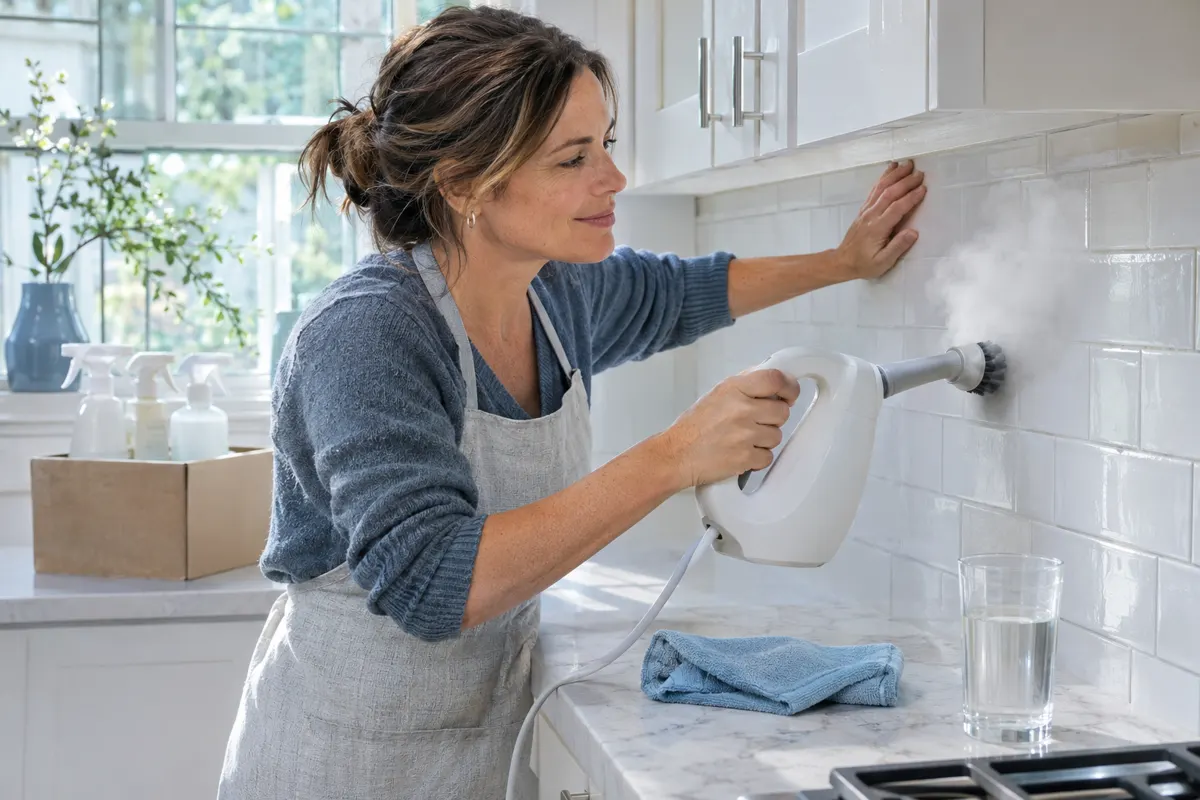
The easiest way to stop worrying about which cleaner contains what is to need fewer cleaners. For a large share of everyday jobs, heat and water do the work: steam at high temperature softens grease on stovetops and backsplashes, loosens grime in grout lines and refreshes upholstery and car seats, with nothing left behind to rinse. Our explainer on how a steam cleaner works covers the science, and what you can steam clean lists the surfaces where it shines and the few to avoid. A handheld steamer such as the Qinux Vapoxis works with nothing but tap water, so there is no ingredient list to check at all.
Our recommendation: Qinux Vapoxis
If the new PFAS rules have you rethinking the cabinet under the sink, the Qinux Vapoxis is the tool we recommend. It is a light handheld steam cleaner that uses only tap water, and its attachments put a short burst of steam exactly where the grime is, so you can clean tile, grout, stovetops, sinks, glass, upholstery and car seats without buying a different spray for each job. It is the most practical way to cut the number of bottles in your home starting this week.
- Just water, no chemicals — no fumes, no residue, no ingredient list to decode.
- Hygienic clean — the maker states its steam eliminates up to 99.9% of bacteria on treated surfaces.
- Precise attachments — jet nozzle, brushes and tools for glass and flat surfaces.
- Light and handheld — easy to grab for a two-minute job.
- One tool for the whole home — kitchen, bathroom, windows, upholstery and car.
Customers rate it 4.8/5 on the official site, and 94% say they would recommend it. A single unit is $109, two are $198, with free shipping, a launch discount of up to 50% and a 14-day money-back guarantee. Sold only through the official website.
Want the full picture first? Our complete Vapoxis review covers results room by room, and the Vapoxis home page has the current prices. This article is general information, not legal advice; always test a hidden spot first and follow the steamer’s instructions and each surface maker’s care guide.
Frequently asked questions
What are PFAS in cleaning products?
PFAS (per- and polyfluoroalkyl substances) are a large family of man-made chemicals that resist water, oil and stains. In some cleaning products they have been used to help liquids spread, repel dirt or leave a protective film. They break down very slowly, which is why they are often called forever chemicals.
Which states ban PFAS in cleaning products in 2026?
Colorado and Maine prohibit the sale of cleaning products with intentionally added PFAS from January 1, 2026, and Connecticut’s prohibition on cleaning products began July 1, 2026 (with a written-notification route for some sellers). Minnesota’s ban on cleaning products started January 1, 2025, and Washington’s ban on cleaning products is scheduled for January 1, 2027.
How do I know if my cleaner contains PFAS?
Labels rarely say PFAS. Ingredient names that contain “fluoro” or “PTFE” are a clue, and products marketed as stain-repellent or leaving a protective coating deserve a closer look. Products certified under the EPA’s Safer Choice program are reviewed ingredient by ingredient. When in doubt, contact the manufacturer.
Do I need to throw away cleaning products I already own?
The state laws restrict what stores and manufacturers can sell; they do not require you to throw away products at home. If you decide to stop using one, follow your local household hazardous waste guidance rather than pouring it down the drain.
Does steam cleaning use any chemicals?
A steam cleaner uses heated tap water, so there is no ingredient list at all. Heat and moisture loosen grease and grime, and the maker of the Qinux Vapoxis states its steam eliminates up to 99.9% of bacteria on treated surfaces. Always follow the steamer’s instructions and test a hidden spot first.